 Login
Login Billpay
Frost Damage on Montana Trees

The unpredictable nature of our current weather patterns, often oscillating rapidly from mild spring conditions back to late-season winter frosts, has unfortunately led to a noticeable increase in frost damage on newly emerging foliage. This type of damage can manifest in a spectrum of ways, depending on the severity of the freeze and the developmental stage of the plant tissue. Below is general information to understand frost damage on trees in Montana.
Understanding the Visual Signs of Frost Damage
The initial signs of frost damage are typically seen on the most vulnerable parts of the leaf.
- Partial Damage: Milder frost events may only affect the outermost parts or tips of the leaves. The water within these exposed cells freezes, expands, and ruptures the cell walls. Later in the growing season, as the rest of the leaf expands normally, these damaged sections, which are essentially dead tissue, do not grow. This differential growth can lead to abnormal leaf deformity, resulting in leaves that are curled, puckered, tattered, or irregularly shaped, often with brown or dead margins.
- Total Leaf Mortality: A more severe or prolonged freeze can kill the entire newly emerged leaf. When the immature tissue freezes completely, it loses its structural integrity. The visual outcome is a striking and unfortunate appearance of blackened and shriveled leaves. This dead foliage often remains attached to the plant for a time, serving as a clear indicator of the freeze event.
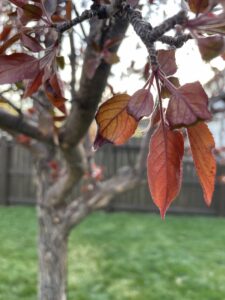
Vulnerability of Early-Budding Trees and Shrubs
A key factor in susceptibility to this damage is the plant’s seasonal development– specifically, its timing of early bud break. Trees and shrubs that tend to bud out early in the spring are inherently more susceptible to late-season frost damage. Their undeveloped tissue is not yet hardened off and is rich in water content, making it highly vulnerable to freezing temperatures. This includes many ornamental varieties and certain fruit trees whose spring growth unfortunately precedes the final, consistent warm weather.
Long-Term Impact and Recovery
While a widespread frost event can look alarming, most established trees and shrubs have the capacity to recover. The plant’s overall health and energy reserves determine the speed of this recovery. Once the threat of frost has passed, the tree will typically attempt to push out a second set of leaves from dormant or secondary buds. Although this process requires a significant amount of stored energy and may temporarily slow the tree’s growth for the season, it is the plant’s natural mechanism for survival.
What Can Homeowners Do
- Monitor affected plants for signs of secondary bud break.
- Ensure the tree receives adequate water and is not experiencing additional stress.
- Check for possible disease or pest infestations.
- Contact your Yard Guard to have our Certified Arborist conduct a full evaluation
