 Login
Login Billpay
Our 5-Step Blended Organic Lawn Care Program
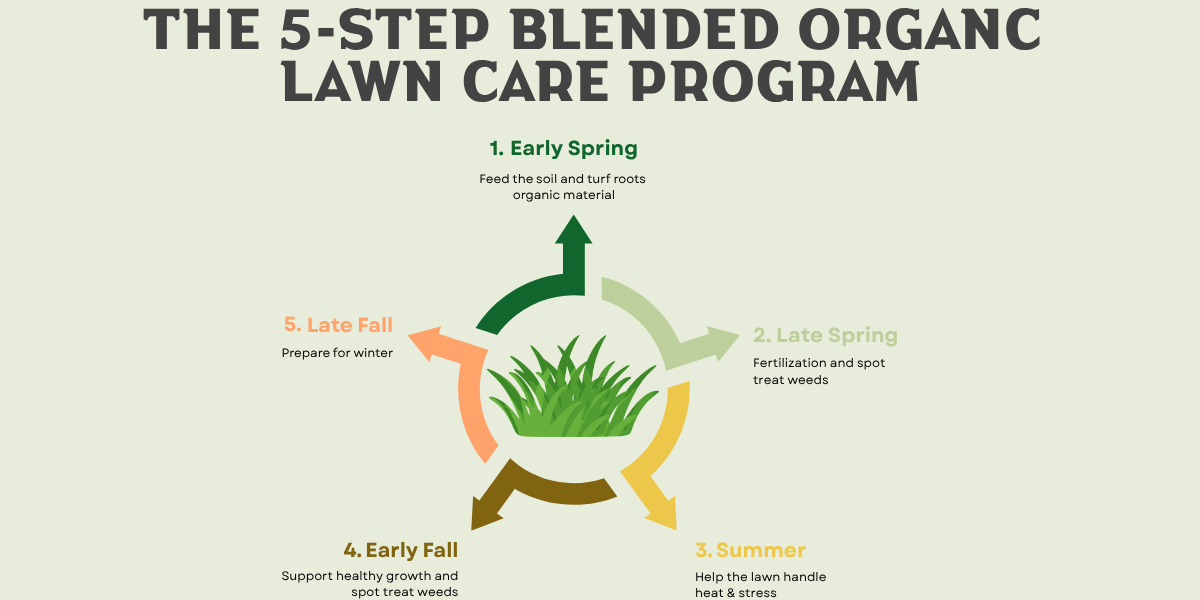
The 5-Step Blended Organic Lawn Care Program in Southwest Montana
If you’re new to Yard Guard, welcome! We’re excited to get to know you and your property. If you’ve been with us for some time now, thank you. We truly appreciate the trust you place in us year after year.
Whether you’re new or have been with us for a while, you may find yourself wondering what the significance of our five-step program is. Many people are familiar with a more traditional three-step approach, so it’s a fair question. The goal here is to walk you through why we recommend five steps, what each one is doing, and how they all work together to create a healthier lawn over time.
Looking at Lawn Care Differently
One of the most common misconceptions in lawn care is that weeds are solved simply by spraying them. While that can work in the short term, it doesn’t actually address the root of the problem.
Weeds tend to show up when a lawn is thin, stressed, or lacking nutrients. In many cases, they’re filling a gap where healthy turf should be. So instead of thinking about lawn care as “weed control,” we take a step back and look at the bigger picture.
A healthy, well-fed lawn is what truly controls weeds.
When your turf is thick and your soil has the nutrients it needs, weeds naturally have a harder time establishing. That’s why our program focuses heavily on fertilization and soil health, using weed control only when it’s actually needed.
Why Five Steps Instead of Three?
Traditional programs can produce good results early on, but over time many lawns begin to decline – losing color, thinning out, and becoming more susceptible to weeds again.
This typically happens because:
- Nutrients are slowly depleted from the soil
- The focus is placed more on removing weeds than building turf
- The lawn isn’t being supported consistently throughout the season
- Synthetic programs can only do so much
Our five-step program is designed to solve that by supporting the lawn at the right times, not just reacting to problems as they show up.
How the 5-Step Program Works
Each step has a specific role depending on what your lawn needs at that point in the season.
Step 1: Early Spring – Waking the Soil Up
Timing: Mid-March through April (weather dependent)
After a long winter, your lawn is coming out of dormancy. Even though it hasn’t been actively growing, the root system has still been slowly using nutrients.
This first application focuses on rebuilding the soil environment. We apply a carbon-based product bonded with peat moss, which helps retain moisture and reintroduce carbon into the soil. Our granular applications make a huge impact on building up organic material in your soil.
Step 2: Late Spring – Growth + Targeted Weed Control
Timing: Late spring through early July
As temperatures rise, both grass and weeds begin to grow more actively. This is where we balance two priorities: continuing to build soil health while managing weeds as needed.
The fertilizer in this step is packed with organic nutrients like kelp, seaweed, molasses, humic and folic acids, compost, organic potassium, iron, and slow-release nitrogen. These ingredients help feed both the plant and the soil.
If weeds are present, we manage them with targeted spot treatments, rather than blanket applications across the entire lawn.
Step 3: Summer – Drought Management
Timing: July through mid-August (weather dependent)
Southwest Montana summers can be hot and dry, which puts stress on even healthy lawns. Because we grow cool-season grasses here, they don’t thrive in strong summer heat. As lawns begin to dry out, they become more susceptible to weed growth – sometimes leaving weeds as the only green pieces in the lawn, commonly seeing thistle as the primary weed during this time.
This application is similar to the makeup of Step 2, but the focus shifts. Instead of encouraging growth, we’re working to support the lawn through stress and give it the nutrients it needs to hang on and stay as healthy as possible during tougher conditions.
If you prefer not to increase your watering schedule during this time, we also offer a Water Saver application, which can help your lawn retain moisture more efficiently and reduce stress during peak summer heat.
Step 4: Late Summer – Supporting the Lawn Through Stress
Timing: Mid August through Mid September
As we move toward late summer, we’re often still experiencing heat and drought conditions, but cooler nights start to return. This is when your lawn begins to recover and become more active again.
During this time, it’s common to see a second round of dandelions pop up. This application continues to use similar nutrient inputs as Steps 2 and 3, but the focus shifts back to feeding the lawn as it begins actively growing again.
The goal here is to take advantage of that natural recovery period and help the lawn regain strength before heading into fall.
Step 5: Fall – Season Wrap-Up + Winter Preparation
Timing: Mid September through end of October (weather dependent)
The fall application is one of the most important of the entire season and it’s also one of the most commonly skipped. We can’t emphasize this enough: just because you’re done with your lawn doesn’t mean your lawn is done growing.
In many ways, your lawn is preparing for winter the same way a bear prepares for hibernation. It’s looking to store nutrients that it can slowly use throughout the winter months. Without this final application, the turf is essentially going into winter without the food it needs.
While things may appear to be slowing down above ground, the root system remains very active below the surface. This step focuses on supporting root sustenance and storing nutrients until the following spring.
What we do in the fall plays a major role in how your lawn looks and performs the next year.
How It All Comes Together
When you look at the program as a whole, it’s not just five individual applications—it’s a progression.
Each step builds on the last:
- We start by improving the soil
- Then feed the lawn and manage weeds
- Then prevent drought conditions
- Then protect it through stress
- And finally prepare it for the next season
That consistency is what leads to long-term results, not just short-term improvements.
Expectations Over Time
With this approach, most customers notice:
- A thicker, greener lawn each season
- Fewer weeds over time
- Improved drought tolerance
- More consistent results year after year
If you ever have questions about where your lawn is in the process or what we’re doing at a given time, we’re always happy to walk through it with you. We believe that understanding the “why” behind the program makes all the difference.
